
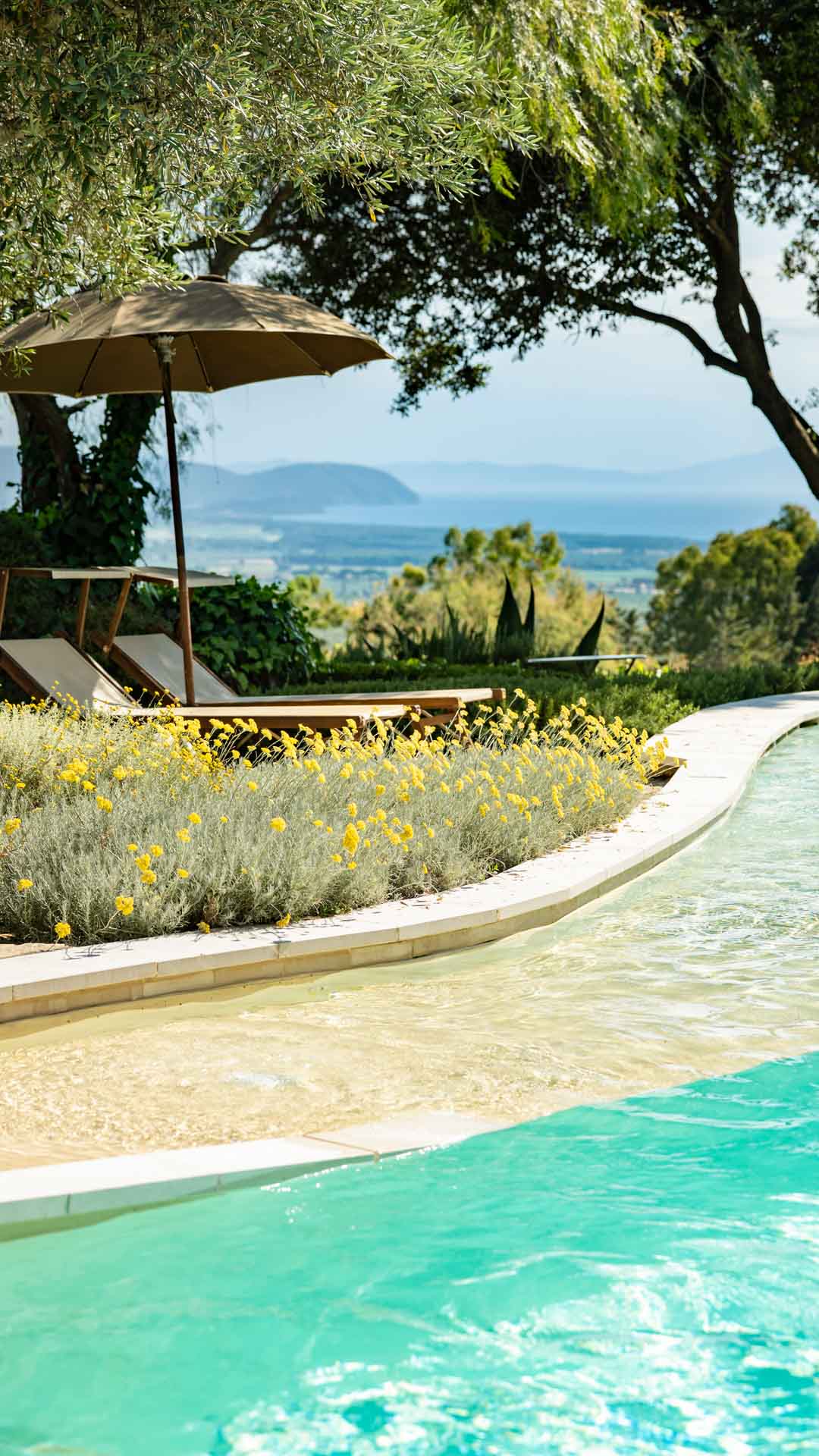
Our summers are growing hotter. The famous Azores High has given way to high-pressure systems pushing up from the northern Sahara, now reaching latitudes that would have seemed unthinkable at the turn of the century. Northern France, England, Germany, Poland — all are breaking temperature records that no one would have imagined twenty years ago.
The paradox lies in the south, on the very shores of the Mediterranean.
Not in the Spanish interior, not in Provence, not across the great plains of northern or central Italy, not in the heart of Greece. But on the coasts. Precisely on the coasts.
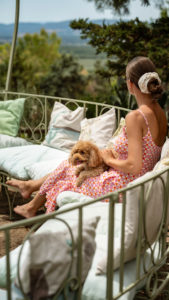
Poggio ai Santi lives this paradox every single day.
We sit five kilometres from the deep blue sea, nestled against our Tuscan hills. Sixty years ago, our Poggio was a bare, sun-scorched, silent hillside. Today it is a generous woodland alternating pine forest, eucalyptus, holm oaks and cypress trees — a breathing, filtering, cooling mass of green. That is the first factor.
But the most powerful one is invisible. It happens twice a day, with the precision of celestial clockwork.
In the morning, as the first heat begins to rise from the land, the sea breeze moves in from the shore — cool and light, climbing toward the hills as if reclaiming its territory. In the evening, the process reverses: the land cools faster than the sea, the air from the heights grows denser, heavier, and drifts gently back down by convection toward the shoreline — carrying with it the dry scents of the Mediterranean maquis.
It is a natural, silent, age-old air conditioning. Twice a day, the Mediterranean and our hills exchange their breath.
Do not be afraid to come south.
Mediterranean coastlines often offer, in the height of summer, a calmer climate than the great continental plains: less stormy, drier, moderated by this immense body of blue water that regulates everything.
And here lies the final wonder of this sea: in summer, it cools. In winter, it warms. It becomes a reserve of gentleness along a few precious kilometres of coastline — no frost, a clear and low winter light, and even the faintest ray of sunshine becoming an invitation. A coffee on the terrace. Lunch outside in January. A walk through the Etruscan hills, in a silence that only winter knows how to offer.